Every business owner we sit down with in Pune eventually asks some version of the same question: “Should I put my budget into Google Ads or SEO first?” It’s usually asked with real financial pressure behind it a fixed monthly marketing budget, a founder who needs to show results to a partner or investor, or simply the frustration of watching a competitor show up first on Google while their own site sits on page three.
Most articles answer this with a shrug: “it depends, do both if you can.” That’s true, but it’s not useful when you’re staring at a spreadsheet trying to decide where the next ₹30,000 goes. This guide gives you the actual decision framework, real cost numbers in rupees, and importantly the sequencing strategy that experienced marketers use but rarely explain publicly: how to make Google Ads and SEO fund each other instead of competing for the same rupee.
The Real Difference Isn’t “Paid vs Free”
The most common way this topic gets explained is wrong in a subtle way. Google Ads isn’t “paid” and SEO isn’t “free” both cost real money, just in different forms.
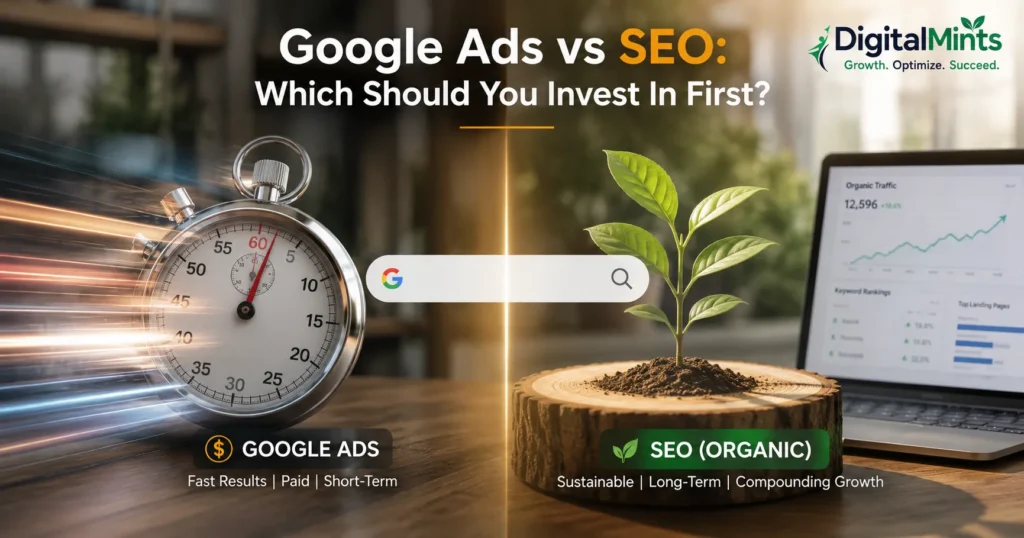
Google Ads is rented visibility. You pay per click, and the moment you stop paying, your traffic drops to zero within hours. What you’re buying is speed and control: you choose the exact keywords, the exact moment your ad appears, and you can be live within a day.
SEO is owned visibility, but it’s built with labour, not rent. You’re paying for content, technical fixes, and ongoing optimisation work upfront, and the “return” arrives later, in the form of rankings that keep generating traffic without a per-click charge. The catch is that Google’s algorithm not you ultimately decides where you land, and that decision increasingly depends on the same trust and credibility signals search quality raters use to judge content, known as E-E-A-T (Experience, Expertise, Authoritativeness, Trustworthiness).
Understanding this distinction changes the question. It’s not “which is better” it’s “which type of investment matches where my business is right now.”

A Real Decision Framework, Not a Coin Flip
Ask yourself these five questions honestly:
1. Do you need leads this month, or can you wait six months? If your cash flow depends on leads arriving in the next 30 days, Google Ads is the only channel built to deliver that. SEO simply cannot promise a timeline that short.
2. Is your target keyword dominated by large, established competitors? If the first page for your main keyword is packed with big national players or long-established local competitors with hundreds of reviews and years of content, ranking organically will take considerably longer. Ads let you compete on that same page immediately, regardless of your domain’s age.
3. Do you already know which offer converts? If you haven’t validated that your service, pricing, and landing page actually convert visitors into leads, spending months on SEO content for an unproven offer is a bigger risk than a two-week ad test.
4. Can you sustain a monthly ad budget indefinitely, or does it need to become self-sufficient? Ads work only as long as you fund them. If your long-term plan is to reduce dependence on a monthly spend, SEO needs to start now, even if Ads carries you in the meantime.
5. Do you have (or can you create) genuinely useful content? SEO rewards businesses willing to publish real expertise guides, FAQs, case studies, area-specific pages. If that’s not something you or your team can commit to, SEO’s return will stall regardless of technical optimisation.
If most of your answers point to speed, competition, and unproven offers start with Ads. If they point to sustainability, content capability, and a longer runway start with SEO. If you’re honestly split, that’s the normal state most businesses are in, and the sequencing strategy further down is built exactly for that situation.
What Google Ads Actually Costs in India Right Now

Generic “average CPC” numbers you’ll find online are usually pulled from US data and are close to useless for budgeting in India. Indian search auctions are structurally cheaper, but they vary enormously by industry. As a planning guide for 2026, here’s roughly what businesses in common Pune sectors are seeing per click on Google Search campaigns:
| Industry | Typical CPC range (₹) | Notes |
|---|---|---|
| Local services (salons, repairs, small clinics) | ₹10 – ₹60 | Lower competition, strong for hyper-local targeting |
| Education & coaching | ₹25 – ₹120 | Entrance coaching and professional courses sit at the higher end |
| E-commerce / retail | ₹15 – ₹80 | Brand + product keyword combinations are usually the most efficient |
| Healthcare & clinics | ₹50 – ₹200 | Varies sharply by specialisation |
| Real estate | ₹80 – ₹300 | High CPC, but high deal value can justify it |
| B2B / manufacturing / enterprise software | ₹100 – ₹400+ | Longer sales cycles mean CPC alone doesn’t tell the full story |
These are planning ranges, not quotes your actual cost depends on your Quality Score, ad relevance, and how tightly your landing page matches the search intent. A well-optimised campaign can pay 30–50% less per click than a poorly built one targeting the exact same keyword. Beyond CPC, the number that actually determines whether Ads makes you money is cost-per-lead: your CPC divided by your landing page’s conversion rate. A ₹40 click with a 5% conversion rate produces an ₹800 lead a very different economic picture than the CPC alone suggests.
What SEO Actually Costs, and Why the Math Works Differently
SEO investment in Pune typically ranges from a focused audit-and-fix project to an ongoing monthly retainer, usually landing somewhere between a few thousand rupees for a narrow scope and considerably more for full content, technical, and link-building programs on a competitive keyword set. The key structural difference: that spend goes toward building an asset a ranking page, a body of content, a stronger domain that keeps generating visits after the invoice is paid, unlike an ad campaign that stops the moment the budget runs out.
The trade-off is patience. Realistic SEO timelines in a competitive market like Pune run 3–6 months for initial movement and 6–12 months for a keyword set to properly mature. Businesses that expect page-one rankings in six weeks are almost always disappointed, and that mismatched expectation is one of the most common reasons Pune businesses abandon SEO too early, right before it was about to compound.
The Strategy Almost Nobody Explains: Let Ads Fund Your SEO Roadmap

Here’s the piece most comparison articles skip entirely, and it’s the single highest-leverage idea in this whole topic: your Google Ads account is also a live, paid keyword research tool.
Every campaign tells you, with real money and real conversions, exactly which keywords, headlines, and offers actually turn into leads data that guesswork-based SEO content planning simply cannot match. The smartest sequencing we recommend to Pune clients looks like this:
- Months 1–3: Run a focused Ads campaign on your 5–10 highest-intent keywords while your SEO foundation (technical fixes, Google Business Profile, core service pages) gets built in parallel.
- Months 4–6: Use the Ads conversion data to identify which keywords and landing page angles actually produce leads, and direct your SEO content investment specifically at those proven winners instead of guessing.
- Months 7–12: As organic rankings begin capturing some of that proven-converting traffic for free, gradually shift ad budget away from the keywords SEO now owns, and reallocate it toward new keyword territory or seasonal campaigns.
This is exactly the opposite of the common mistake we see most often in Pune: splitting a small budget 50/50 across both channels from day one, which underfunds both and produces mediocre results on each. A concentrated budget, sequenced deliberately, consistently outperforms a diluted one.
Which Should Come First, By Industry
- Real estate: Ads first deal values are high enough to justify aggressive CPCs while SEO content for individual projects and localities builds in the background.
- Healthcare & clinics: SEO first, supported by light Ads trust and reviews (E-E-A-T signals) matter enormously for medical decisions, and organic visibility tends to convert better for this category.
- Education: Both together Ads for admission-season urgency, SEO for the year-round informational searches that build long-term enrolment pipelines.
- Manufacturing & B2B: SEO first buying cycles are long, decision-makers research extensively, and a strong content and case-study presence outperforms cold ad clicks.
- Retail & e-commerce: Ads first, especially for new product launches, with SEO built alongside for category and blog content that keeps working after campaigns end.
- Hospitality: Both Ads for immediate bookings and offers, SEO and Google Business Profile optimisation for the discovery searches that happen well before a booking decision.
Common Mistakes We See Pune Businesses Make
- Turning Ads off the moment leads slow down, without ever checking whether the landing page or offer was the actual problem.
- Starting SEO with no clear keyword priority, publishing generic content instead of the specific, locally-relevant pages that actually rank.
- Ignoring Google Business Profile and reviews while spending the entire budget on Ads or blog content local trust signals affect both channels.
- Judging SEO after 6 weeks instead of 6 months, and abandoning it right before it compounds.
- Never connecting Ads conversion data back into the SEO content plan, wasting the cheapest keyword research available.
The Bottom Line
There’s no universally correct answer to “Google Ads or SEO first” there’s only the correct answer for your specific timeline, budget, and industry, and it can change as your business matures. If you need revenue this quarter, start with Ads. If you’re building a business you want to still be ranking for in three years, SEO needs to start now, even if Ads is what pays the bills in the meantime. The businesses that get the most out of both channels aren’t the ones who picked the “right” one they’re the ones who sequenced them deliberately, using paid data to make organic decisions instead of guesses.
Frequently Asked Questions
Can I really do both Google Ads and SEO at the same time on a small budget?
Yes, but avoid splitting the budget evenly. It’s usually more effective to fund one channel properly while the other gets a foundational, lower-cost start, rather than underfunding both simultaneously.
How long before SEO starts producing leads for a Pune business?
Most businesses see initial ranking movement within 6–10 weeks and meaningful, stable lead flow between 4 and 8 months, depending on competition in the specific keyword set.
Does stopping Google Ads hurt my SEO rankings?
No, Google’s organic algorithm doesn’t factor in ad spend. However, you will lose the paid visibility and lead flow immediately, which is why the two channels need to be planned together, not swapped abruptly.
Which is cheaper long-term, Ads or SEO?
SEO typically produces a lower cost per lead over time because you stop paying per click, but it requires sustained content and technical investment to maintain rankings it isn’t a one-time cost either.
This article was researched and written by the Digital Mints editorial and performance marketing team, a Pune-based digital agency managing Google Ads and SEO programs for 100+ local businesses across real estate, healthcare, education, retail, and manufacturing. Want a specific recommendation for your budget and industry? Get a free consultation.