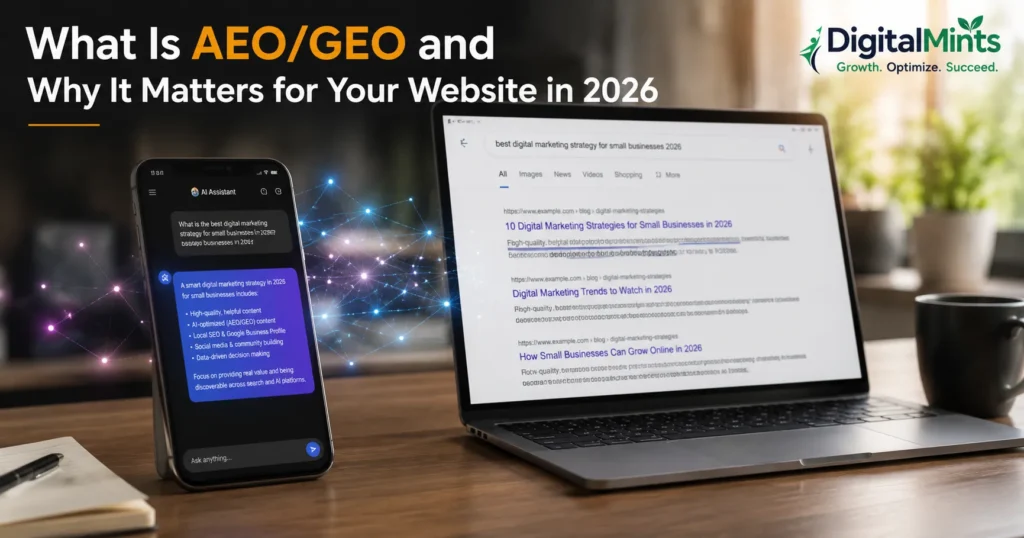
Type a question into Google today and there’s a good chance you won’t click a single link. You’ll read an AI Overview, get your answer, and move on. Ask the same question to ChatGPT, Gemini, or Perplexity instead of Google, and you might not visit a search engine at all. For business owners who spent the last decade learning to “rank on page one,” this shift feels disorienting the page one you optimised for isn’t always the page being read anymore.
This is the world AEO and GEO were built for. Both terms get thrown around loosely, sometimes as marketing buzzwords attached to services that can’t actually be measured. This article cuts through that: what AEO and GEO actually mean, how they’re different from each other and from traditional SEO, why they matter specifically for a Pune business in 2026, and a practical, honest checklist for getting started including what nobody can legitimately promise you.
AEO, GEO, and SEO: Three Related but Different Disciplines

SEO (Search Engine Optimisation) is the discipline you already know improving your website so it ranks well in traditional search engine results pages, earning clicks through organic listings.
AEO (Answer Engine Optimisation) is the practice of structuring your content so that search features and AI systems can extract a direct, accurate answer from it this includes Featured Snippets, People Also Ask boxes, Google AI Overviews, and voice assistant responses. AEO’s target is narrower and more tactical: making a specific piece of content extractable as a direct answer.
GEO (Generative Engine Optimisation) is the broader, strategic discipline of building your brand’s presence, credibility, and citability across generative AI platforms like ChatGPT, Gemini, Claude, and Perplexity not just one page at a time, but your overall footprint across the web that these systems draw from when they decide who to mention.
A simple way to hold these apart: SEO gets you onto the results page. AEO makes a specific piece of your content the answer. GEO builds the broader reputation that gets your brand recommended by name, even outside Google entirely.
Why This Isn’t Optional Anymore
The scale of this shift is no longer a prediction it’s already visible in how people search. A meaningful share of Google searches now end without any click at all, because the answer already appeared directly on the results page. Separately, AI chat platforms have grown into a genuine second channel for discovery: hundreds of millions of people now use tools like ChatGPT and Gemini regularly, and a growing number of those conversations include local, commercial questions “which is a good accountant near Baner,” “compare CRM software for a small manufacturing business,” “best packers and movers in Pune.”
Here’s what makes this urgent rather than theoretical: when someone gets their answer inside an AI Overview or a chatbot response, they often never see your website at all unless your business is the one being cited. If you’re relying purely on traditional blue-link rankings, you’re now competing for a shrinking share of total search attention even if your rankings haven’t moved.
How Answer Engines Actually Decide Who to Cite
This is the part most surface-level AEO articles skip. AI systems don’t cite sources randomly, and they don’t cite the highest-ranked page by default either. Research analysing citation patterns across major AI platforms has consistently pointed to a few controllable factors:
- Clear, structured answers. Content that leads with a direct, self-contained answer ideally one to two sentences followed by supporting detail, gets extracted far more reliably than content that buries the answer in a long narrative introduction.
- Verifiable evidence. Pages that include specific data, named sources, and concrete examples are cited noticeably more often than pages making vague, unsupported claims. Independent research has found that adding expert quotes, statistics, and citations each measurably increases how often a page gets referenced by generative engines.
- Entity clarity. AI systems process content by identifying entities first recognising your business as a specific organisation in a specific category before evaluating keyword relevance. A business whose name, category, and identity are consistently and clearly defined across its site and the wider web gets recognised faster and more confidently than one with inconsistent branding.
- Freshness. Especially for anything involving pricing, availability, or rapidly-changing information, AI systems favour recently updated content over stale pages, even if the stale page still ranks well organically.
- Cross-platform consistency. Different engines lean on different signal sources Google’s AI Overview draws heavily from your existing top-10 organic rankings, while platforms like Perplexity weight freshness and broader authority more heavily, and B2B-focused tools lean on professional platforms like LinkedIn. A GEO strategy has to account for this instead of treating all AI platforms as one target.
Where E-E-A-T Fits Into All of This
Google’s E-E-A-T framework Experience, Expertise, Authoritativeness, Trustworthiness was designed for human quality evaluation of search results, but it turns out to be almost exactly the same lens AI systems use when deciding what to cite. This isn’t a coincidence: both are trying to answer the same underlying question “can this source be trusted enough to put in front of someone making a decision?”
For a Pune business, that means the unglamorous trust-building work genuine team bios, transparent contact information, real customer reviews, accurate and consistent business listings, content written by people who demonstrably know the subject isn’t separate from your AEO/GEO strategy. It’s the foundation it’s built on. A perfectly-structured FAQ page from a business with no discoverable credibility signals will still lose out to a less polished page from a source AI systems consider trustworthy.
A Practical AEO/GEO Checklist

1. Rewrite key pages with a question-first structure. Use an actual question as your heading, answer it directly in the first sentence or two, and only then go into detail, examples, and nuance. This single change improves both featured snippet eligibility and AI citation odds simultaneously.
2. Build a real, specific FAQ section on your most important pages. Not generic filler questions the actual questions your customers ask before buying, phrased the way they’d type or say them.
3. Add structured data (schema markup) that matches your visible content. FAQPage, Article, HowTo, Organization, and Person/Author schema are the highest-impact types for AEO. Schema only works when it accurately reflects what’s genuinely on the page mismatched or inflated schema can backfire.
4. Make your entity identity unmistakable. Ensure your business name, category, address, and description are consistent across your website, Google Business Profile, LinkedIn, industry directories, and any press mentions. Inconsistency slows down how confidently AI systems recognise who you are.
5. Support claims with real evidence. Where possible, cite specific numbers, name real sources, and include short, attributable expert quotes from your own team. This is one of the few tactics with measurable research backing behind it.
6. Keep time-sensitive content genuinely fresh. Pricing pages, service lists, and FAQ answers should be reviewed and updated on a real schedule, not left untouched for years.
7. Build authority beyond your own domain. Genuine mentions on local business associations, industry publications, LinkedIn, and review platforms feed both traditional SEO authority and GEO citability they’re not separate efforts.
8. Track your AI visibility, not just your rankings. Periodically ask ChatGPT, Gemini, and Perplexity the kinds of questions your customers would ask, and see whether your business gets mentioned. This is currently the most reliable way to gauge GEO progress, since formal analytics for AI citations are still maturing.
What AEO/GEO Cannot Promise You
This deserves to be said plainly: no agency, tool, or consultant can guarantee placement inside an AI-generated answer. These systems are probabilistic, they change frequently, and no business has direct control over an AI model’s output the way you can control a website’s on-page structure. Anyone promising guaranteed AI citations is overselling what’s actually possible. What a well-run AEO/GEO strategy can honestly deliver is a meaningfully improved probability of citation, achieved through the same fundamentals that also strengthen traditional SEO which is exactly why it’s worth doing regardless of how quickly AI search itself evolves.
What This Looks Like for a Pune Business Specifically

For local Pune businesses, the practical opportunity is still wide open, mainly because most local competitors haven’t restructured their content yet. A clinic in Kothrud that rewrites its service pages with clear question headings and real FAQ content has a genuine shot at being the source an AI system cites when someone asks “which is a good physiotherapist near Kothrud” not because of aggressive SEO tactics, but simply because almost nobody else in that category has done the structural work yet. The same applies across real estate, education, manufacturing, and retail categories across Pune’s micro-markets. This first-mover window won’t stay open indefinitely as more businesses catch on, which is exactly why starting now even with a handful of well-restructured pages carries more relative advantage today than it will in a year.
The Bottom Line
AEO and GEO aren’t a replacement for SEO, and they’re not a shortcut around the trust-building work that E-E-A-T has always demanded. They’re an extension of the same fundamentals into a search landscape that now includes AI Overviews and chat-based assistants as genuine discovery channels alongside traditional results pages. The businesses that treat this as “one more thing to optimise” a year from now will be competing against the ones who quietly restructured their content, tightened their entity identity, and built real citable authority in 2026, while the opportunity was still uncrowded.
Frequently Asked Questions
Is AEO/GEO replacing traditional SEO?
No. Every major analysis of this shift agrees that strong SEO fundamentals crawlability, indexability, useful content, technical health remain the foundation AEO and GEO are built on top of, not a separate track.
How do I know if my business is being cited by AI tools?
Manually test it: ask ChatGPT, Gemini, and Perplexity the real questions your customers would ask, and note whether your business appears. Dedicated AI-visibility tracking tools are emerging, but manual testing remains the most accessible starting point for most small businesses.
Does GEO work differently for each AI platform?
Yes. Google’s AI Overview tends to pull heavily from existing top-ranking organic content, while platforms like Perplexity weight freshness and broader authority more heavily, and B2B-focused queries often lean on professional platforms. A one-size-fits-all approach underperforms a platform-aware one.
How long does it take to see results from AEO/GEO work?
Because this discipline is still young, timelines are less predictable than traditional SEO. Businesses that restructure key content typically start seeing snippet and AI Overview appearances within weeks, while broader GEO citability tends to build over several months alongside ongoing authority-building work.
This article was researched and written by the Digital Mints editorial team, a Pune-based digital marketing agency helping local businesses build both traditional search rankings and AI answer engine visibility. Curious where your website currently stands with AI search tools? Request a free AEO/GEO visibility check.